
GESTURES + Private Equity
My obsession with the PE industry continues...

Hortonioni (aka me) is back home after two weeks in Tokyo! Thanks for reading — today’s article is one I’ve been working on for a while as I’ve compiled my research on Private Equity in a way I hope is helpful and informative. Please leave a <3 if you enjoy, it goes a long way in appeasing the algorithm and spreading the good word. Or comment in the section at the end of this post!
As I’ve been chatting with people about my new film, GESTURES, I’ve hit this interesting problem where I’ll talk about the concept and I get a blank stare back: Liza’s corporate dreams are thrown into crisis when her boss Cheryl goes missing on the eve of a groundbreaking Private Equity deal. Then I ask, “do you know what Private Equity is?” And many people don’t! Which is exactly how the very opaque PE industry would have it, so they’ve done a great job on that.
What exactly is the private equity industry? It’s a mind-boggling apex of our absurd economic system!!
Do you remember when Toys R Us went bankrupt, closed all its locations and workers were suddenly out of jobs that they’d held for decades? Do you have an elder family member receiving poor care at a facility? Or do you find it suspicious that your healthcare provider is suddenly a terrible experience, shuffling you quickly through the door and charging you for every utterance the doctor makes? Then you are already well-acquainted with the private equity industry!
The industry has about $22 trillion dollars in assets, so you very likely engage with a PE-owned business on the daily. PE companies like The Blackstone Group, KKR & Co., and Apollo Global, own hospitals, real estate, apartment buildings, single-family houses, health centers, elder care homes, make-up brands, energy companies, Walgreens, CVS and JoAnn Fabrics (bankrupt), just to name a few.

Private equity is a financial structure that buys companies with debt (a leveraged buyout) and then manages those companies to increase the returns for it’s investors (the ones supplying the debt). However, it’s the purchased company that is on the hook for repaying that debt — not the PE firm.
The PE firm becomes a managerial structure on top of the purchased business, whose sole function is to increase profits -- whether that’s by managing the business “better” or more likely by selling the business’s real estate, reducing jobs, benefits, cutting corners, or changing what the business does all together. They might decide it’s actually more profitable to file for bankruptcy and shut down the company altogether. Firms take a 2% management fee as well as 20% of the profits, so they’ll make a very decent amount independent of how well the company fares.
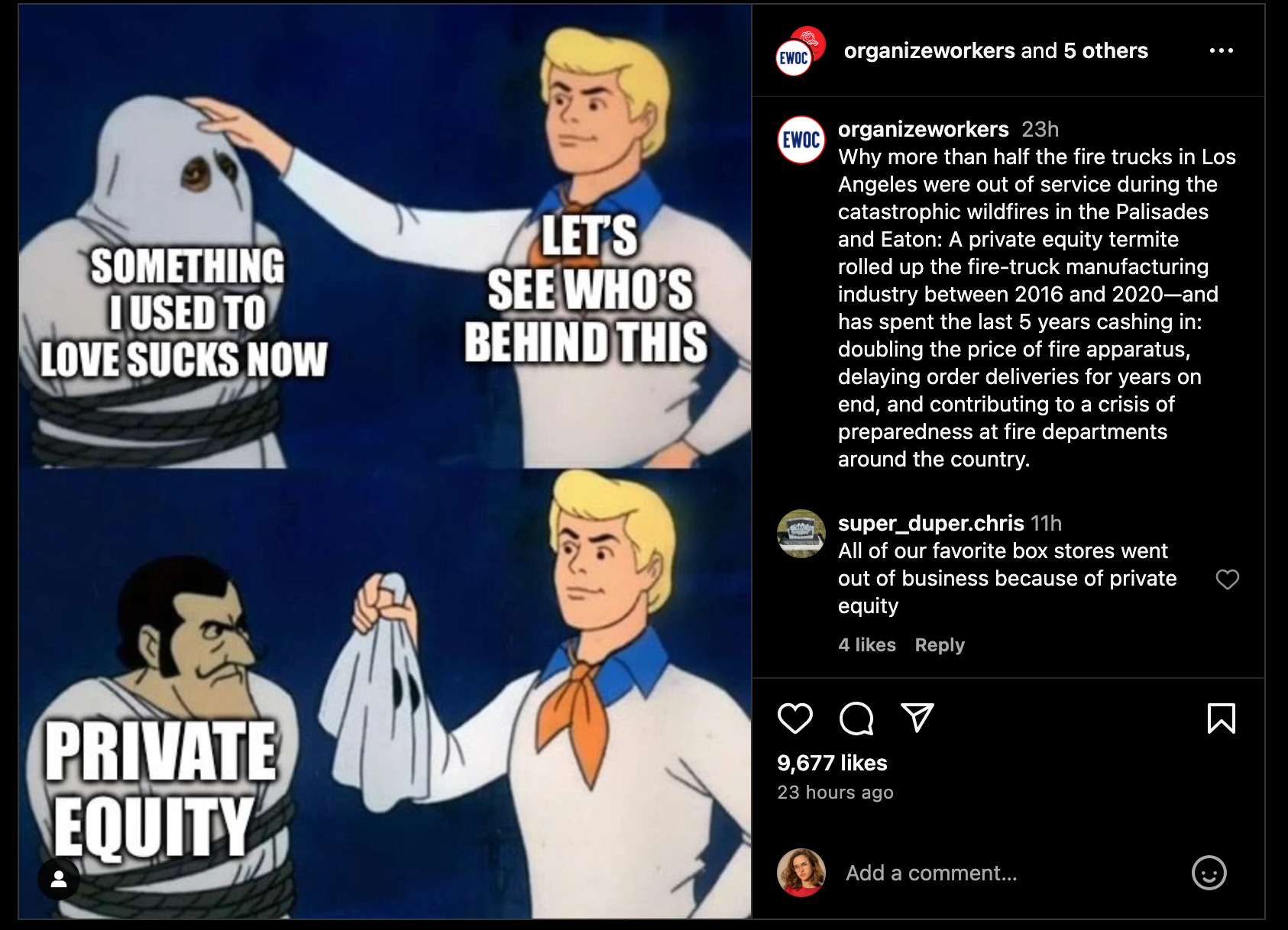
Is there a reason for these companies to exist? Not in my opinion. Do they contribute to society in any way at all? Nooooo. Are they the pinnacle of the value-extraction, self-immolating, ever-expanding capitalist system that we live under? Oh yeah, baby!
Plus — they are private. Unlike public companies on the stock market, PE firms don’t have to provide records, open their books, face public scrutiny. Everything, including their profit reporting, happens behind closed doors. It’s kind of amazing that this exists, eh??
“To create value where there was none before” has somehow become a life’s purpose for many. And to confirm, that “value” is money. And “create” means extract.
The PE firm in GESTURES, Klingfield Lion & Price, is not a real company. Real PE firms aren’t buying towns like Deer Valley...YET. It’s not hard to imagine the fictional scenario of Deer Valley becoming a reality in America very soon. Corporations taking over the government is very much already in practice!

If you want to learn more about PE, here are a few places to start:
Private Equity Stakeholders Project
Slash & Burn: Is Private Equity Out of Control?
The Secretive Industry Devouring the US Economy
How Private Equity Shapes Our Lives: A Deep Dive with Gretchen Morgenson
😱😱😱